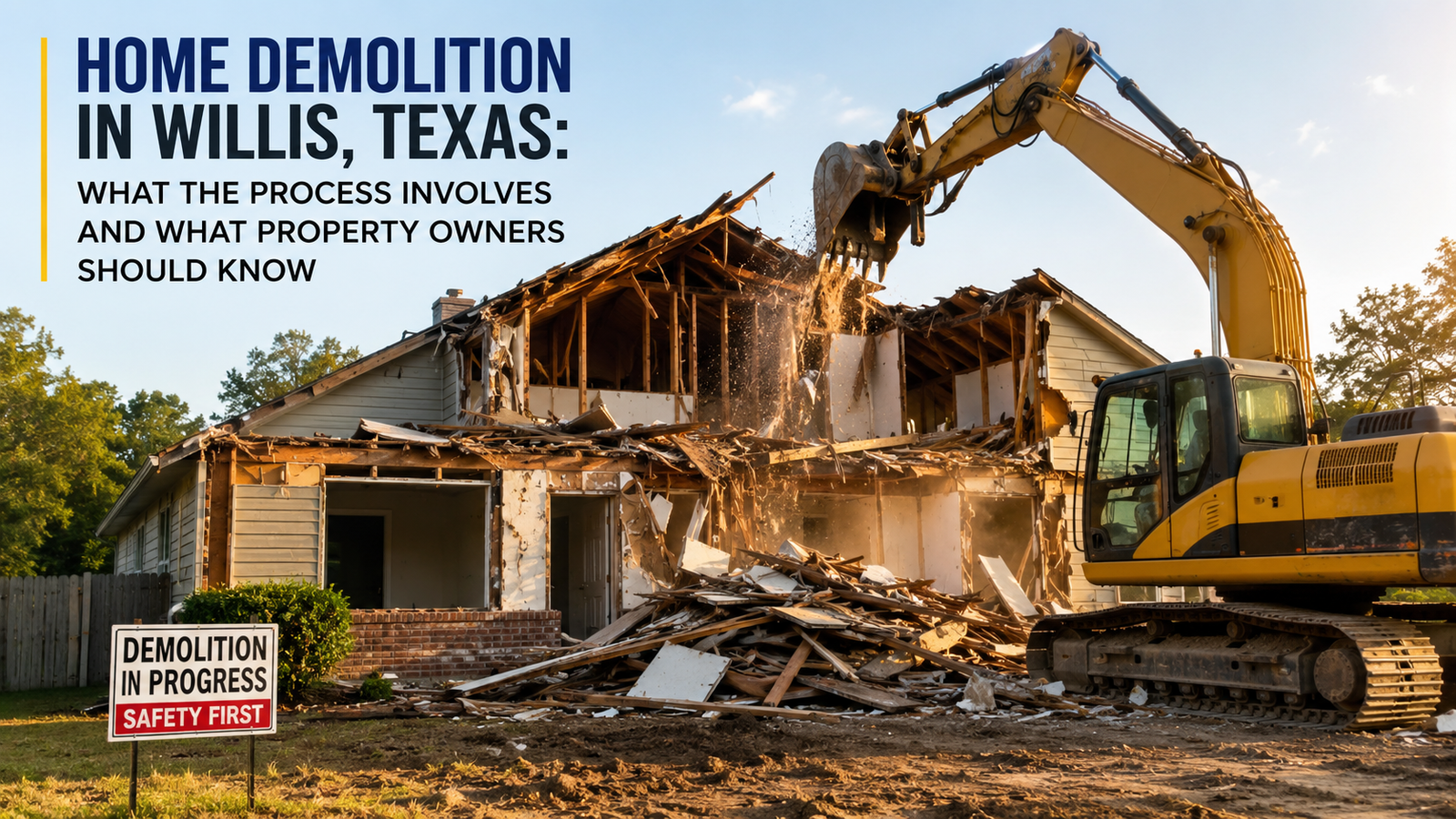
Willis, Texas sits in the northern reaches of Montgomery County, a region that has experienced some of the most sustained residential growth in the Greater Houston area over the past two decades. Lake Conroe’s shoreline communities, the expanding neighborhoods north of The Woodlands, and the rural acreage tracts throughout the county have all drawn new development and with new development comes the need to address older, outdated, or deteriorated structures that no longer fit the property’s current or planned use. Home Demolition Willis in Willis is a service in regular demand, and understanding what the process actually involves helps property owners make informed decisions before a project begins.
Why Homes Are Demolished in Willis and Montgomery County
The reasons property owners in Willis pursue home demolition fall into several distinct categories. Structural deterioration is among the most common. Older homes that have not been adequately maintained particularly those affected by the moisture, humidity, and heat of the East Texas climate can reach a condition where renovation is no longer economically sensible. Wood rot in framing, foundation issues driven by Montgomery County’s expansive clay soils, mold infiltration, and the accumulated deferred maintenance of decades can all push a home past the threshold of repair.
Flood damage is a specific and significant driver in this region. Montgomery County, and the communities along Lake Conroe and the San Jacinto River watershed, have experienced significant flood events that have left some residential structures saturated, structurally compromised, and beyond practical recovery. When a home has been repeatedly inundated, the combination of structural wood damage, mold remediation requirements, and the ongoing flood risk can make teardown and elevated rebuilding the most rational path forward.
Redevelopment is another category. As land values in the Willis area and along Lake Conroe have risen with the region’s growth, some older homes on valuable lots are purchased specifically to be demolished and replaced with new construction better suited to current market expectations. This teardown-and-rebuild pattern is common in communities where the land itself carries substantial value.
Finally, property owners may demolish accessory structures garages, barns, outbuildings, mobile homes, and sheds that have outlived their usefulness or are in the way of new construction. These smaller-scope demolitions are among the most frequently requested services in the Willis and Conroe area.
What Willis Requires Before Demolition Can Begin
The City of Willis has established specific requirements that must be satisfied before any structure can be legally demolished. The Willis permit code is explicit: a demolition permit must be secured prior to the demolition or moving of any structure, either in whole or in part. This requirement applies to residential structures as well as commercial buildings, and it applies to partial demolition as well as complete teardowns.
The permit application process confirms that the planned demolition meets applicable code requirements and that all necessary prerequisites have been addressed. One of the most important prerequisites is asbestos survey for structures that may contain asbestos-containing materials. The City of Willis references TCEQ requirements and the Texas Occupations Code on asbestos health protection any public building being demolished must have an asbestos survey prior to demolition, and responsible practice extends this requirement to residential structures of uncertain age or material composition. Structures built before 1980 are the primary concern, as asbestos was widely used in insulation, floor tiles, ceiling tiles, roofing, and various other building products during this period.
The Willis demolition permit also specifically requires that after demolition, the site be graded to drain and returned to a predevelopment condition. This is not merely a courtesy it is a code requirement that reflects the importance of proper drainage in a region where heavy rainfall and the drainage patterns of the Lake Conroe watershed make stormwater management a genuine community concern.
Utility disconnections are another essential prerequisite. Gas, electric, water, and sewer connections to the structure must be properly disconnected and capped before demolition equipment touches the building. In Willis and surrounding Montgomery County areas, this means coordinating with Entergy Texas for electric, CenterPoint Energy for gas where applicable, and the relevant water utility provider.
The Home Demolition Process in Willis
With permits secured and prerequisites satisfied, the physical demolition of a home in Willis follows a structured sequence. The approach depends on the type of structure wood-frame construction (the most common residential building type in Willis), masonry, manufactured or mobile home, or a combination and on the size and site conditions.
For wood-frame homes, which dominate Willis’s residential building stock, mechanical demolition with an excavator is the standard approach. A mid-size excavator typically in the 20-to-40-ton class for a full house is highly effective at breaking apart wood-frame construction efficiently and safely. The operator works from the top down, beginning with the roof structure and working through the exterior walls and interior framing. The resulting debris is loaded directly into hauling trucks as it is generated, keeping the work area manageable throughout the process.
Manufactured and mobile homes which are prevalent across the rural and semi-rural areas of Montgomery County surrounding Willis present their own demolition considerations. These structures are typically lighter than site-built homes but can contain materials of varying quality and condition, and their construction style (often steel chassis with wood or metal wall framing) requires different techniques than traditional site-built construction. Mechanical demolition with a smaller excavator or skid steer is typically appropriate.
Debris management in Montgomery County has a distinctive characteristic compared to more urbanized areas: open burning of combustible demolition debris is available in many rural Willis area locations where burn permits can be obtained from the Texas Forest Service or applicable local authority. This means that clean wood framing, siding, and other combustible materials can sometimes be burned on-site, significantly reducing the volume of material that must be hauled away and lowering overall project debris disposal costs. Non-combustible materials concrete from slabs and foundations, metal roofing and framing, wire, and other non-burnables must still be loaded and hauled to appropriate disposal or recycling facilities.
Foundation Removal After Home Demolition
After the above-grade structure is demolished and debris cleared, the foundation remains unless specifically addressed. In Willis, residential foundations come in two primary types: slab-on-grade foundations (the most common in modern residential construction throughout the region) and pier-and-beam foundations (more common in older homes and some rural construction).
Whether foundation removal is required depends on the intended future use of the site. For a lot that will be immediately redeveloped with a new home, the existing foundation typically must be removed to allow proper subgrade preparation for the new structure. For a lot that will be used for agricultural purposes, recreational use, or simply cleared for resale, foundation removal may or may not be specifically required but leaving a concrete slab in the ground creates long-term complications including differential settlement, interference with drainage, and obstacles to any future ground disturbance.
Concrete from demolished foundations in Willis is typically recycled as crushed aggregate, which has active demand throughout the North Houston and Montgomery County construction market. This recycling pathway reduces disposal costs and provides a productive second life for the material.
Site Restoration After Home Demolition in Willis
The Willis demolition permit requirement for post-demolition site grading to drain and return to predevelopment condition reflects a practical reality: a cleared lot with uncontrolled drainage can create problems for neighboring properties and for the cleared site itself. Montgomery County’s heavy clay soils, which are slow to drain and prone to ponding, make proper grading a meaningful concern rather than a formality.
Professional site restoration after home demolition in Willis includes rough grading of the lot to establish positive drainage away from the cleared building footprint and toward street or natural drainage outlets; erosion control measures such as silt fence along the site perimeter and mulch or seed on exposed soil surfaces; and in some cases finish grading to a specific design grade when redevelopment is planned.
The combination of demolition and site restoration services offered by experienced Willis-area demolition contractors provides property owners with a complete solution from standing structure to cleared, graded, permit-compliant lot without the need to coordinate multiple separate contractors for different phases of the work.
Common Questions About Home Demolition in Willis
Does the City of Willis require a permit to demolish a house? Yes. The Willis demolition permit code requires a permit prior to demolition or moving of any structure, in whole or in part. The permit must be secured before work begins, and the completed project must meet the post-demolition site grading requirements specified in the permit.
Can demolition debris be burned on site in Willis? In the rural and semi-rural areas surrounding Willis, open burning of clean combustible demolition debris may be permitted under applicable Texas Forest Service or local burn permit authority. This depends on current fire weather conditions, the specific location, and the type of material being burned. An experienced local demolition contractor familiar with Montgomery County burn permit requirements can advise on whether on-site burning is available for a specific project.
How long does a house demolition take in Willis? The physical demolition of a typical single-family home in Willis usually takes one to three days for the structural teardown. Foundation removal, site grading, and debris hauling add additional time depending on scope and site conditions. The total project timeline including permit acquisition and any required utility disconnection coordination is typically several weeks from initial planning to completed site.
What is done with the concrete from the foundation? Concrete from demolished Willis-area foundations is typically crushed and recycled as aggregate base material. This material is widely used throughout the North Houston and Montgomery County construction market as road base, driveway base, and fill material.